




Why language models are the future of enterprise intelligence
Large language models can read, summarise, answer and draft at a scale no team can match, but only when they are grounded in the organisation’s own knowledge and governed properly. BluEnt designs, builds and deploys enterprise LLM solutions, from strategy and model choice to assistants integrated into everyday tools, with data protection and accuracy built in.
- Enterprise knowledgeDocuments, data and systems
- Grounded retrievalThe right context, securely
- Language modelOpen or commercial
- Useful answersAssistants teams rely on
LLMs in brief
 Who it serves
- CTOs, CIOs, chief data officers, product leaders and teams with large document estates
 What it covers
- LLM consulting, custom development, integration, chatbots and virtual assistants, and deployment
 Models
- Open models such as LLaMA and Mistral, and commercial models such as Claude, GPT and Gemini
 Approach
- Use case, data readiness, prototype, production and monitoring
 How it starts
- An LLM Strategy Session

Why generic chatbots fall short
A language model on its own knows the internet, not the organisation.
Without grounding, governance and integration, answers are generic, sometimes wrong, and risky to share.
Enterprise value comes from models that draw on the organisation’s own documents and data, respect who may see what, sit inside the tools teams already use, and are monitored for accuracy and cost.
- Generic answersResponses that ignore the organisation’s own knowledge.
- Made-up factsConfident answers with no source behind them.
- Data exposureSensitive information shared with the wrong people or services.
- Unchecked costUsage that grows faster than the value it brings.
What enterprise LLMs deliver
Language models that work with the organisation’s knowledge, securely and accurately.
| Capability | What it delivers |
|---|---|
| Grounded answers | Responses drawn from approved documents, with sources |
| Knowledge assistants | Search and question-answering across the document estate |
| Summarisation | Long documents and threads condensed for decisions |
| Drafting | First drafts of reports, emails and content |
| Customer support | Virtual assistants that resolve routine questions |
| Secure access | Answers limited to what each user is allowed to see |
Full-spectrum LLM services
Five services, from deciding where language models fit to running them in production.
Select a service to explore
Plan
LLM consulting for enterprises
Where language models will add value, which model fits, and what the data and governance need to look like.
- Use cases prioritised by value
- Model choice: open or commercial
- Data readiness and governance
- Cost and risk assessment
Build
Custom LLM development
Models adapted to the organisation’s domain, language and tasks.
- Retrieval over enterprise documents
- Fine-tuning where it helps
- Prompt and evaluation design
- Accuracy testing against real questions
Connect
LLM integration services
Language models connected to the systems and data teams already use.
- APIs into business applications
- Connections to document stores and databases
- Workflow automation
- Permission-aware access
Assist
LLM chatbots and virtual assistants
Assistants for employees and customers that answer accurately and hand over when needed.
- Internal knowledge assistants
- Customer-facing virtual assistants
- Hand-off to people for complex cases
- Conversation analytics
Run
LLM deployment services
Language models run securely, reliably and within budget.
- Private cloud or managed deployment
- Guardrails and content controls
- Monitoring of accuracy and cost
- Ongoing tuning and support
The stack behind enterprise LLMs
Models and tools are chosen for accuracy, cost, auditability and the organisation’s data rules.
- Open modelsLLaMA and Mistral, for control and auditability
- Commercial modelsClaude, GPT and Gemini, for performance through robust APIs
- Retrieval and dataSearch over the organisation’s documents and data
- Deployment and guardrailsSecurity, monitoring and content controls
Product names show the platforms BluEnt works with. They do not indicate a formal partnership.
From the first use case to assistants in daily use
An approach that keeps accuracy, security and cost in view at every stage.
Choose the use case
The business problem, users and success measures are agreed.
Prepare the knowledge
Documents and data are organised, permissions mapped and sensitive content protected.
Prototype and evaluate
A working assistant is tested against real questions for accuracy and safety.
Deploy and monitor
The solution goes live with guardrails, and accuracy and cost are monitored.

A generic chatbot, or an enterprise language model
What it knows
A generic chatbot: The public internet
An enterprise language model: The organisation’s own knowledge
Answers
A generic chatbot: Unsourced
An enterprise language model: Grounded, with sources
Data protection
A generic chatbot: Unclear
An enterprise language model: Permission-aware
Cost and accuracy
A generic chatbot: Unmonitored
An enterprise language model: Measured and tuned
Why partner with BluEnt
Enterprise-ready language models need data engineering, governance and AI skills together. BluEnt brings all three, so assistants are grounded in the organisation’s knowledge, respect its data rules and keep delivering once they are live.
- Grounded in the organisation’s dataAnswers with sources
- Secure by designPermission-aware access
- Model-neutralOpen or commercial, on merit
- IntegratedInside everyday tools
- MonitoredAccuracy and cost tracked
About our clients
- HFS: research data unified for analytics, with HubSpot automation and integration.
- WellSky: integration and analytics on governed healthcare data.
- Gearbox and Epic: reconciled finance and gift-card data behind reporting.

Delivery model and security
Offices in the US, Canada, the UK, the Netherlands and India. How delivery works.
SOC 2 Type I and Type II attestations held. Security & SOC 2.
Related links
Large language models are part of AI services and solutions, alongside machine learning. They depend on well-governed data and AI governance, privacy and compliance.
Insights
Perspectives from BluEnt on generative AI and language models.
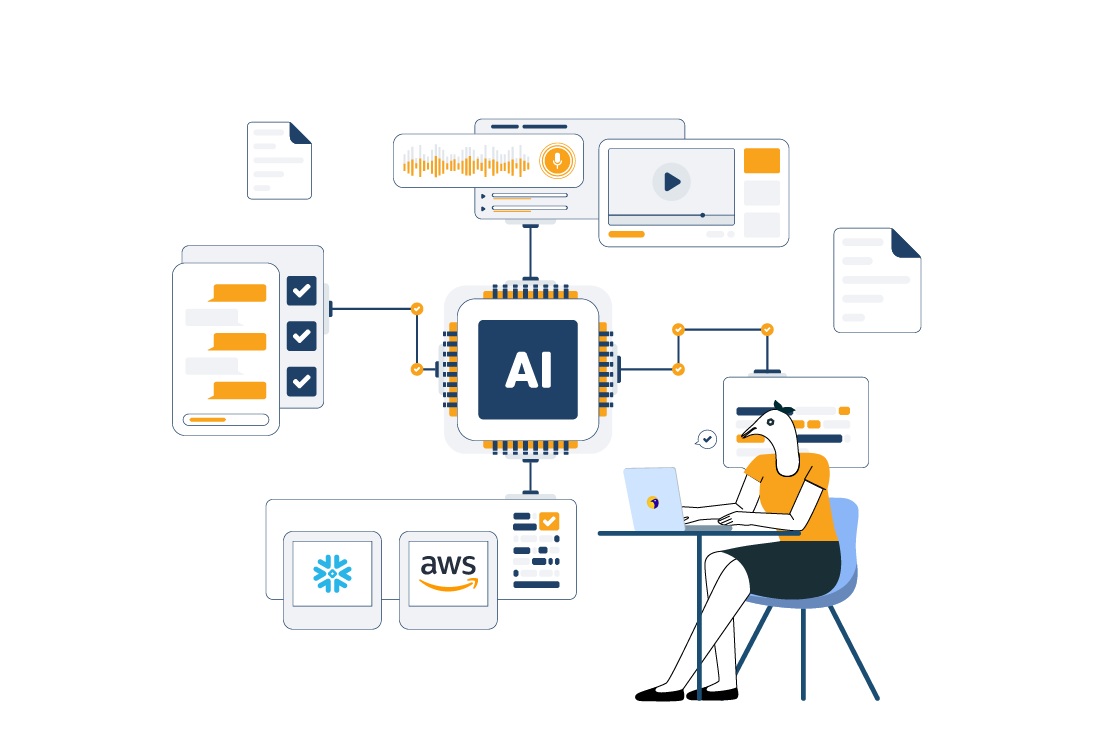 InsightFrom GenAI strategy to executionPutting generative AI to work on a modern data platform.Read the article
 InsightAI governance framework for AEC organisationsGoverning Copilot, digital twins and generative design.Read the article
 InsightMachine learning modelsHow models are built, trained and kept accurate.Read the article
Questions data leaders ask

What is the difference between a chatbot and an enterprise LLM solution?
A generic chatbot answers from general knowledge. An enterprise solution is grounded in the organisation’s own documents and data, respects permissions and is monitored for accuracy.
Should the organisation use an open or a commercial model?
It depends on control, auditability, cost and performance needs. Open models such as LLaMA and Mistral offer control; commercial models such as Claude, GPT and Gemini offer performance through robust APIs.
How are made-up answers avoided?
By grounding answers in approved sources through retrieval, testing against real questions and showing sources with each answer.
Is company data kept secure?
Access is permission-aware, sensitive content is protected, and deployment options include private cloud.
Can the assistant work inside existing tools?
Yes. Language models are integrated with business applications, document stores and workflows teams already use.
Where does AI and large language models work usually begin?
With an LLM Strategy Session to choose the first use case and assess data readiness.
Where do AEC firms start with AI on project files?
For architecture, engineering and construction firms, see the Information Hub.
"*" indicates required fields
Your information is used only to reply to this enquiry and is never shared outside BluEnt. Privacy policy
