


Trustworthy data and responsible AI
AI raises the stakes for every organisation that holds personal or sensitive data. Leaders need to move quickly with AI while staying within privacy law, industry regulation and their own ethical standards. BluEnt builds the governance that makes this possible: privacy and data protection, regulatory compliance management, responsible AI governance and clear accountability for how data and models are used.
Legal advice on privacy or regulation is not included; it stays with the organisation’s counsel.
- Enterprise dataPersonal and sensitive data
- Privacy and protectionControls and consent
- Responsible AIFair, transparent, accountable
- Confident adoptionInnovation within the rules
AI governance in brief
 Who it serves
- Executives, chief data and risk officers, compliance and legal teams, and the people building AI
 What it covers
- Privacy governance, regulatory compliance, responsible AI governance, and data accountability and ethics
 Regulations
- Frameworks such as GDPR, HIPAA, US state privacy laws and emerging AI regulation
 Approach
- Assessment, framework design, implementation and continuous oversight
 How it starts
- An AI Governance Readiness Review

Why AI needs governance first
AI adoption is moving faster than the controls around it.
Teams adopt AI tools before anyone has agreed how data may be used, who is accountable, or which rules apply.
Without a governance framework, AI can expose personal data, embed bias and create regulatory risk that only surfaces later. Governance lets the organisation balance innovation with compliance, rather than choosing between them.
- Privacy exposurePersonal or sensitive data used in AI without the right controls.
- Regulatory riskObligations that are not mapped to any control or owner.
- Hidden biasModels making decisions nobody has checked for fairness.
- No accountabilityNobody answerable for how a model was trained or used.
What AI governance puts in place
The controls, roles and evidence that let AI be adopted responsibly.
| Control | What it provides |
|---|---|
| Data classification | Personal and sensitive data identified and labelled |
| Privacy controls | Consent, minimisation and access rules applied to data and models |
| Regulatory mapping | Obligations mapped to named controls and owners |
| AI use policies | Agreed rules for which AI tools may use which data |
| Model oversight | Review of models for fairness, transparency and risk |
| Audit evidence | Records that show how data and models are governed |
Four parts of responsible governance
A strategy that covers privacy, compliance, AI and accountability together.
Select a part to explore
Protect
Privacy governance and data protection
Personal and sensitive data protected wherever it is stored, shared or used by AI.
- Data classification and labelling
- Consent and data minimisation
- Access controls and retention rules
- Privacy impact assessments
Comply
Regulatory compliance management
Obligations understood, mapped to controls and evidenced for audit.
- Regulations mapped by jurisdiction and domain
- Controls and owners for each obligation
- Monitoring of regulatory change
- Evidence for audits and regulators
Govern
Responsible AI governance
AI adopted within agreed principles, with models reviewed before and after they go live.
- AI use policies and approved tools
- Model risk and fairness reviews
- Explainability for important decisions
- Human oversight where it matters
Answer for it
Data accountability and ethics
Clear ownership of how data and models are used, with ethics built into decisions.
- Owners for data and models
- Ethics review for sensitive uses
- Escalation for AI incidents
- Metrics for leadership
Governance shaped around the rules that apply
Each organisation’s framework reflects its own regulatory landscape.
- Data protection lawGDPR and comparable privacy regimes
- Industry regulationHIPAA and sector-specific obligations
- US state privacy lawsState-level consumer privacy requirements
- Emerging AI regulationRules for AI systems as they develop
From readiness review to governed AI in use
An implementation approach that balances innovation with control.
Assess readiness
Current AI use, data, regulations and controls are reviewed with leadership.
Design the framework
Privacy controls, AI policies, compliance mapping and roles are designed.
Implement
Controls are put in place in data platforms and AI workflows, with owners named.
Oversee and improve
Models and controls are monitored, and the framework evolves with regulation.

AI adopted quickly, or AI adopted responsibly
Personal data
AI adopted quickly: Used without clear rules
AI adopted responsibly: Classified and protected
Regulation
AI adopted quickly: Discovered after the fact
AI adopted responsibly: Mapped to controls
Model decisions
AI adopted quickly: Unexplained
AI adopted responsibly: Reviewed and explainable
Accountability
AI adopted quickly: Unclear
AI adopted responsibly: Named owners for data and models
Why partner with BluEnt
Governance that lets organisations adopt AI with confidence: practical frameworks that balance innovation and regulation, built by a firm that governs its own data with care. SOC 2 Type I and Type II attestations held.
- Privacy firstData protected by design
- Regulation-awareObligations mapped to controls
- Responsible AIPrinciples put into practice
- Clear accountabilityOwners for data and models
- MeasuredMetrics for leadership
About our clients
- WellSky: analytics and reporting on governed healthcare data, where privacy controls matter.
- HFS: research data and HubSpot automation handled within agreed access rules.
- Gearbox and Epic: finance and gift-card data with controlled access for reporting.

Delivery model and security
Offices in the US, Canada, the UK, the Netherlands and India. How delivery works.
SOC 2 Type I and Type II attestations held. Security & SOC 2.
Related links
AI governance, privacy and compliance sit within enterprise data governance. They rely on data quality, catalogues that classify sensitive data, and an operating model with clear owners, and they underpin AI services.
Insights
Perspectives from BluEnt on AI governance.
 InsightAI governance framework for AEC organisationsGoverning Copilot, digital twins and generative design.Read the article
 InsightData governance for AI and advanced analyticsBuilding a governance foundation that works for AI.Read the article
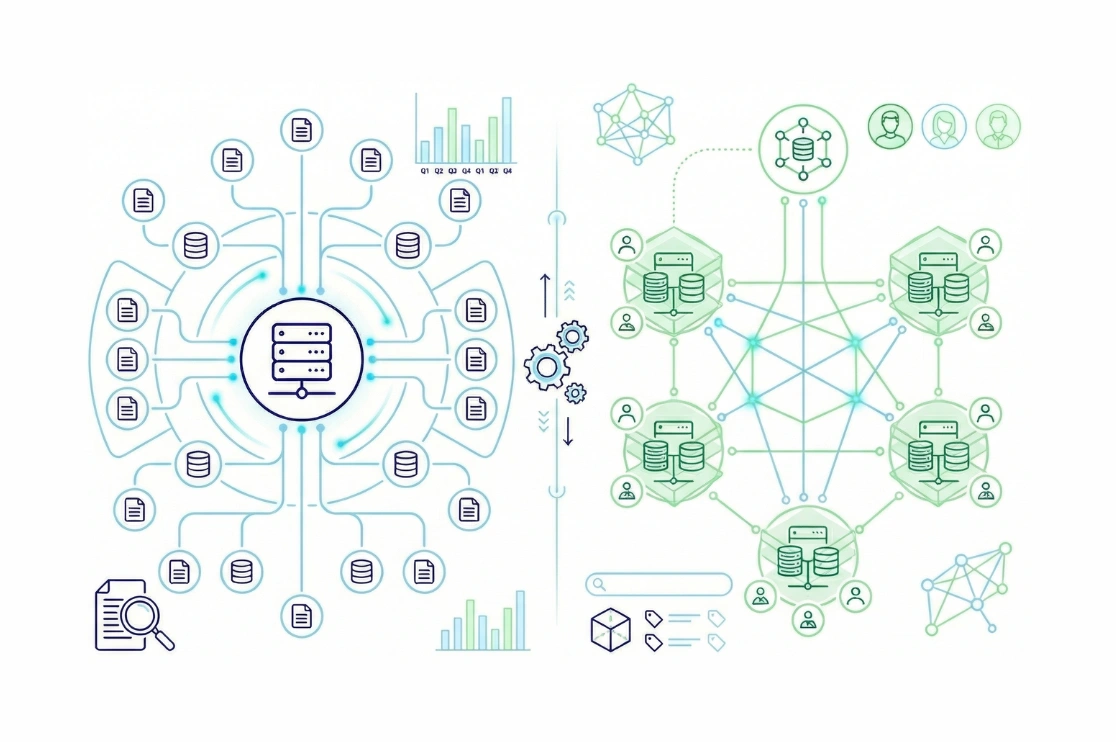 InsightCentralised, federated or hybrid governanceWhich governance model fits the organisation.Read the article
Questions data leaders ask

Why should leadership prioritise AI governance?
Because AI multiplies both the value and the risk of data. Governance lets the organisation adopt AI with confidence rather than slowing it down later.
How can innovation be balanced with compliance?
By agreeing AI use policies, privacy controls and approved tools early, so teams can move quickly within clear rules.
What risks come without an AI governance framework?
Exposure of personal data, regulatory penalties, biased decisions, reputational damage and models nobody can explain.
How can AI governance be measured?
Through metrics such as models reviewed, obligations mapped to controls, incidents resolved and the share of AI use covered by policy.
What role does executive leadership play?
Leaders set the principles, sponsor the framework and make sure accountability is clear across the organisation.
How does a AI governance, privacy and compliance engagement start?
With an AI Governance Readiness Review of current AI use, data and obligations.
Does BluEnt offer AI governance for AEC firms?
For architecture, engineering and construction firms, see AI Governance & Data Handling.
"*" indicates required fields
Your information is used only to reply to this enquiry and is never shared outside BluEnt. Privacy policy