

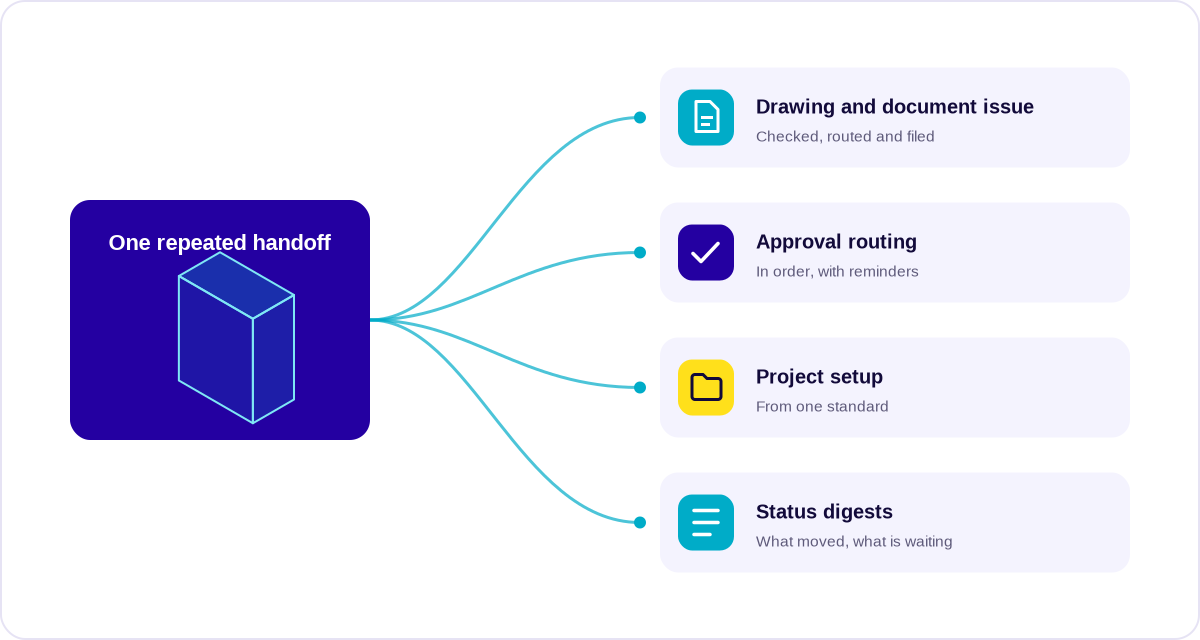
A Power Automate construction workflow takes a repeated handoff, such as a drawing issue, an approval or a new project setup, and runs it the same way every time.
Naming a product describes the work; it is not a partnership claim.
It is built in Power Automate and SharePoint, inside the firm’s own Microsoft 365 tenant.
At a glance
 Who it is for
- Design technology leads, document controllers and IT teams in AEC firms
 Inputs
- The handoffs to automate, the firm’s folder and naming conventions, and access to a test area in its tenant
 Outputs
- Working workflows, a description of each, a runbook and the test record
 Who is responsible
- BluEnt builds and tests. The firm’s IT team owns the tenant, licences and permissions
 Engagement shape
- A build with named workflows, agreed in writing before work begins

Why the same handoff keeps waiting
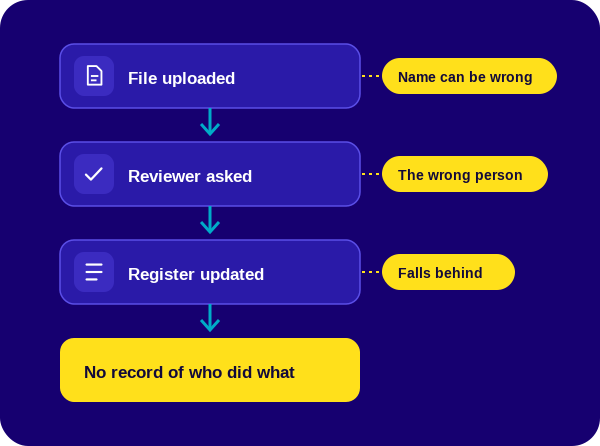
A handoff done by hand is done a little differently each time.
File names drift, the wrong reviewer is asked, and the issue register falls behind the documents it describes.
Because each step depends on someone remembering it, the handoff waits whenever that person is busy, and there is no record of who did what, or when.
What a Power Automate construction workflow build delivers
A named workflow, built and tested in the firm’s own Microsoft 365 environment.
| Workflow | What it does |
|---|---|
| Drawing and document issue | Checks file names on upload, routes the set for approval, files it in the issued folder and notifies the team |
| Approval routing | Moves reviews between people in order, with reminders and a record of each decision |
| Project setup | Creates folders, permissions and templates for each new project from one standard |
| Transmittals and registers | Keeps the issue register current as documents move |
| Status digests | Sends a regular summary of what moved and what is waiting |
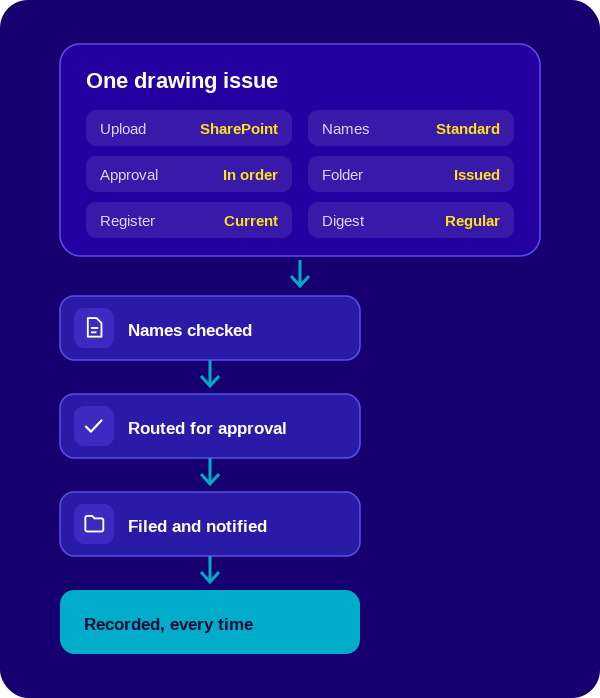
How the work runs
From one stalled handoff to a documented workflow the firm owns.
Map the handoff
The handoff is mapped as it runs today, step by step, with the people who do it.
Agree the route
BluEnt drafts the route, including who approves what; the firm approves it.
Build
The workflow is built in a test area of the firm’s tenant.
Test
It is tested with real documents, and every issue is resolved with the firm’s team.
Hand over
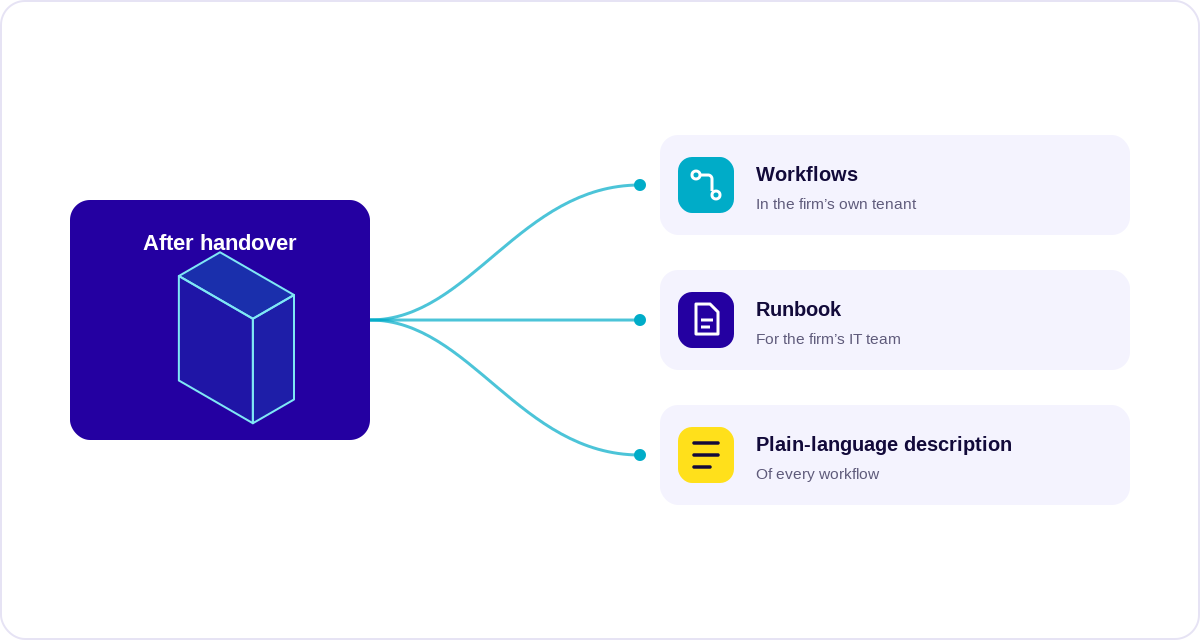
It is handed to the firm’s IT team with descriptions, a runbook and the test record.

Done by hand, or done the same way every time
File names
Done by hand: Checked when someone notices
Done the same way every time: Checked on upload
Reviews
Done by hand: Whoever is remembered
Done the same way every time: In order, with reminders
The issue register
Done by hand: Updated when there is time
Done the same way every time: Kept current as documents move
A record of who did what
Done by hand: Spread across email
Done the same way every time: Kept for every step
What the firm keeps
The workflows run in the firm’s own tenant and belong to the firm. The runbook lets its IT team maintain them, and each workflow is described in plain language, so it does not depend on the person who built it. Licensing needs are identified and agreed with the firm’s IT team before the build begins.
What this does not cover
- The work uses Microsoft 365 workflows, rather than Autodesk Design Automation API development or custom platform extensions.
- Data moved between Procore, Autodesk Construction Cloud and other systems is covered by Procore and ACC data workflows.
- Microsoft 365 licences, tenant administration and security configuration remain with the firm’s IT team.
Drawing production is delivered through bluentcad.com, not through this service.

Delivery model and security
Offices in the US, Canada, the UK, the Netherlands and India. How delivery works.
SOC 2 Type I and Type II attestations held. Security & SOC 2.
Questions AEC professionals ask

Does the work run inside the firm’s own Microsoft 365?
Yes. Workflows are built and tested in the firm’s own tenant, and they belong to the firm after handover.
What licences are needed?
That depends on the workflows. Licensing needs are identified and agreed with the firm’s IT team before the build begins.
Who maintains the workflows afterwards?
The firm’s IT team, using the runbook and the description of each workflow.
Can a workflow be changed later?
Yes. Each workflow is described in plain language, so the firm’s team can change it without depending on the person who built it.
Is it tested before it goes live?
Yes. Every workflow is built in a test area and tested with real documents before handover.
Where does workflow orchestration build work usually begin?
With a Project Data Walkthrough, at no charge, centred on workflow orchestration build: one page naming the specific problems found, and one named next step.
"*" indicates required fields
Your information is used only to reply to this enquiry and is never shared outside BluEnt. Privacy policy