


Data waits for no one. Neither should the business.
BluEnt builds robust, scalable ETL and data pipelines that turn raw data into real-time intelligence. Whether the data is structured or unstructured, moving in batches or as it happens, this is the backbone of data-driven decision-making: the invisible infrastructure behind analytics, AI and automation.
- Raw dataDatabases, apps, files, streams
- Extract and transformCleaned, validated, enriched
- Load and integrateWarehouse or lakehouse
- Real-time intelligenceAnalytics, AI and automation
Pipelines in brief
 Trusted by
- Chief data and analytics officers, data engineers and architects, heads of analytics and BI, CIOs, CTOs and IT directors
 Data handled
- Structured or unstructured, in batches or in real time, migrated from legacy systems or built from scratch
 Platforms
- AWS Glue, Azure Data Factory, Google Cloud Dataflow, dbt, Airflow, Informatica, Talend and Fivetran
 Delivered on
- Azure, AWS, Google Cloud or hybrid set-ups
 How it starts
- A Free ETL Strategy Call, or a Free Architecture Review

Why traditional pipelines fall short
Outdated, rigid or patchwork data flows quietly drain what the business could do with its data.
They delay decisions, inflate costs and stall innovation.
Data infrastructure should accelerate progress, not slow it down. ETL is the engine room of analytics and AI: historical context, compliance-ready archives and seamless integration across systems all depend on it.
- DelaysSlow loads mean stale data, and stale data means stale decisions.
- Inefficient transformationsWasted cloud storage and compute, paid for every month.
- Manual processesA higher risk of data loss and weaker governance.
- Legacy systemsA bottleneck for every agile initiative that depends on them.
ETL & data pipeline offerings
Automated, self-healing and observable data flows, matched to the organisation’s scale, cloud and goals.
| Offering | What it delivers |
|---|---|
| Managed ETL as a service | Data flows run, monitored and kept to agreed terms, while the organisation keeps full control of its data |
| Real-time and streaming | Event-driven integration for decisions that cannot wait for an overnight load |
| AI-assisted transformations | Anomaly detection, drift flags and predictive models applied as data moves |
| Warehouse and lakehouse integration | Loads tightly integrated with the warehouse, BI tools and machine-learning models |
| Legacy modernisation | Rigid, hand-built jobs rebuilt as automated, observable ones |
| Orchestration and monitoring | Scheduling, alerting and observability, so failures are seen and fixed early |
Four ways the work is delivered
Not every organisation wants to run its data flows in-house, and not every load needs to run in batches.
Select a way to explore
Managed
ETL as a service
Operations are taken off the organisation’s hands while it keeps full control: BluEnt handles the plumbing, performance and agreed terms, so the team can focus on outcomes.
- Delivered on Azure, AWS, Google Cloud or hybrid set-ups
- Suited to fast-scaling teams, analytics teams and enterprises moving to cloud-native models
Real time
Real-time ETL and streaming
Real-time insight leads to real-time decisions. Streaming runs on event-driven architectures and message brokers such as Apache Kafka, Amazon Kinesis and Google Pub/Sub.
- Fraud detection
- IoT telemetry streams
- Real-time inventory and logistics monitoring
- Customer behaviour analytics
Intelligent
Smart transformations with AI and ML
Moving data is only the start. Machine-learning operations and AI-driven logic are built into the transformations themselves.
- Detect anomalies
- Flag data drift
- Apply language or predictive models as data moves
- Personalise feeds and recommendations in-stream
Integrated
Warehouse and lakehouse integration
Data is only as useful as where it lands. Targets such as Snowflake, BigQuery, Redshift and Synapse are integrated with source systems, BI tools and models.
- Slowly changing dimensions
- Snapshots and audit trails
- Time-travel queries
- Partitioning for performance
The tools behind the work
Platforms are chosen to fit the data strategy, the team’s skills and future goals, never pushed for their own sake.
- ETL tools and platformsNiFi, Talend, Informatica, Glue, Data Factory, Dataflow, dbt, Matillion, Stitch, Fivetran
- Real-time enginesKafka, Kinesis, Flink, Spark Streaming
- Orchestration and monitoringAirflow, Prefect, Prometheus, Grafana, Datadog
- DestinationsSnowflake, BigQuery, Redshift, Synapse, Delta Lake, Databricks
Product names show the platforms BluEnt works with. They do not indicate a formal partnership.
From first source to running data flows
Four stages, from the sources the organisation has today to data flows that run, recover and report on themselves.
Map the sources
Every source, format, volume and refresh need is mapped with the people who rely on the data.
Design the flow
Batch, streaming or both, on the platform that fits the organisation’s cloud and skills.
Build with checks
Validation, monitoring and alerting are built in from the start, so failures are visible.
Run and optimise
The work is handed over, or run as managed ETL, and tuned for speed, spend and scale.

Patched together, or engineered to last
When data is ready
Patched together: After overnight loads and fixes
Engineered to last: In batches or in real time, as needed
When a load fails
Patched together: Found when a report looks wrong
Engineered to last: Alerted and recovered
Cloud spend
Patched together: Inflated by inefficient transformations
Engineered to last: Tuned to the workload
Governance
Patched together: Manual and risky
Engineered to last: Built in from the start
Why partner with BluEnt
Results that matter, not just deliverables: integration with the existing stack, measured on performance, built with compliance and data security in mind, and ready for analytics and AI. Work like this runs today for clients including WellSky, with MuleSoft and SSIS integration, and Gearbox and Epic, with data integration for reporting and analytics.
- Seamless integrationFits the existing estate
- ROI and performanceMeasured on speed and spend
- Compliance and securityGovernance built in
- AI and analyticsData ready for models
- Tailored solutionsMatched to scale and goals
About our clients
- WellSky: MuleSoft integration, and analytics in Tableau, Microsoft SQL Server and SSIS.
- Gearbox and Epic: data integration for reporting and analytics.
- HFS: HubSpot automation and integration, with data analytics and dashboards.

Delivery model and security
Offices in the US, Canada, the UK, the Netherlands and India. How delivery works.
SOC 2 Type I and Type II attestations held. Security & SOC 2.
Related links
ETL is one part of data engineering and modernization. It feeds the warehouse or lakehouse, carries data through a cloud migration, and lands on platforms such as Snowflake and Databricks.
Insights
Perspectives from BluEnt on data integration and engineering.
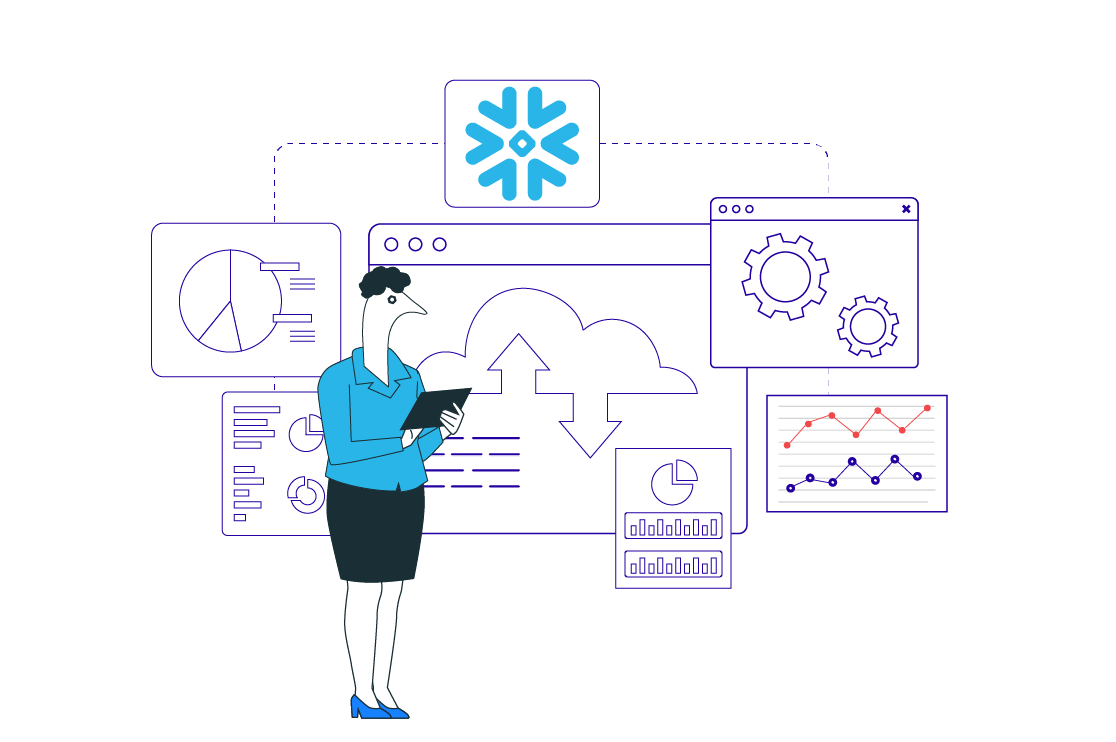 InsightSnowflake ETL for multi-source dataHow to bring several sources into one Snowflake model reliably.Read the article
 InsightReal-time analyticsWhen real-time data matters, and what it takes to deliver it.Read the article
 InsightCloud data engineeringHow cloud-native engineering is changing data platforms.Read the article
Questions data leaders ask

What is the difference between ETL and ELT?
ETL transforms data before it is loaded; ELT loads it first and transforms it inside the warehouse. The right choice depends on the platform and the workload, and many organisations use both.
Can data be processed in real time?
Yes. Streaming runs on event-driven architectures with message brokers such as Kafka, Kinesis or Pub/Sub, alongside scheduled batch loads where those make more sense.
What does managed ETL include?
Running, monitoring and maintaining the data flows to agreed terms, while the organisation keeps full control of its data and platform.
Which tools are used?
Whichever fits: Glue, Data Factory, Dataflow, dbt, Airflow, Informatica, Talend, Fivetran and others, chosen for the organisation’s strategy and skills.
How are failures caught?
Monitoring and alerting are built in, so a failed or partial load is visible and recovered rather than found later in a report.
How does a ETL and data pipelines engagement start?
With a Free ETL Strategy Call, or a Free Architecture Review of what is in place today.
"*" indicates required fields
Your information is used only to reply to this enquiry and is never shared outside BluEnt. Privacy policy